
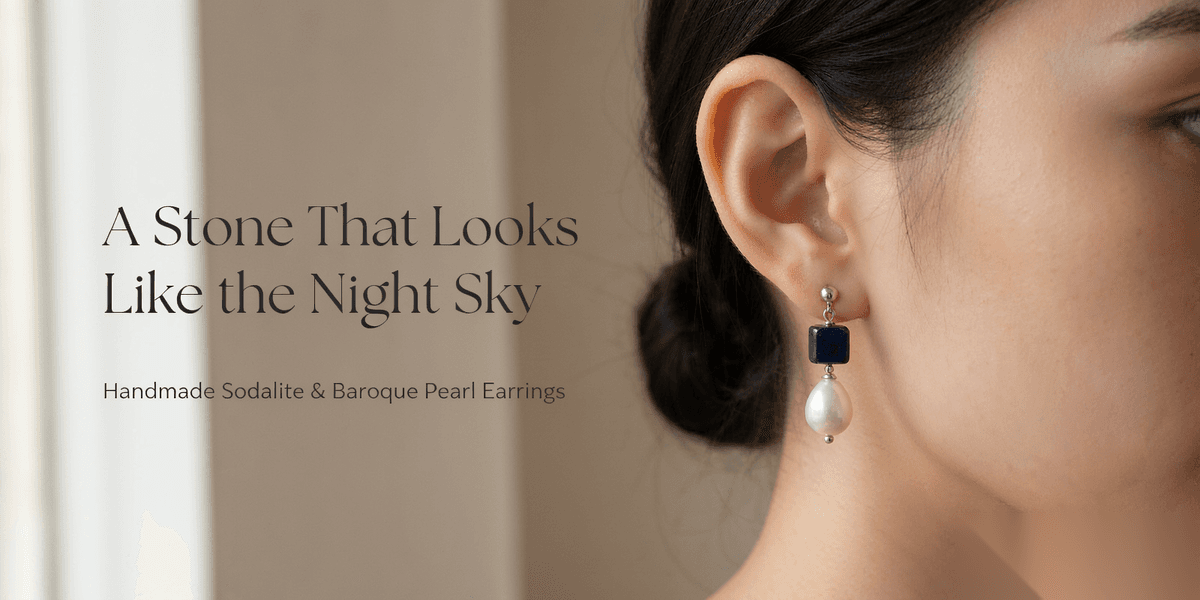
Blue Sodalite & Baroque Pearl Earrings: When Ancient Stone Meets Organic Pearl
March 11, 2026
A handmade pair of earrings that pairs deep blue sodalite with natural baroque pearls. Sodalite’s midnight-blue body and white calcite veins meet the irregular, soft luster of baroque pearls—a combination that is mineral and organic, structured and free at the same time. Since the product page could not be accessed, this article focuses on the two signature materials and what they bring to a handmade piece of jewelry.
A Stone That Looks Like the Night Sky
Sodalite is not a stone that tries to be something it isn’t. Its blue is deep and opaque, closer to the color of a night sky than to the bright, translucent blues of sapphire or aquamarine. What makes it immediately recognizable, however, is what runs through it: veins of creamy white calcite, sometimes accompanied by traces of other minerals .
This blue-and-white pattern is entirely natural and entirely unrepeatable. No two pieces of sodalite carry the same striations. In that sense, sodalite is already a kind of fingerprint before it is ever set into jewelry.
Sodalite is often compared to lapis lazuli—the two share a deep blue palette—but they are not the same. Lapis typically contains flecks of golden pyrite; sodalite is distinguished by its white veining and its lack of pyrite inclusions . Historically, sodalite was even called “Canadian Lapis Lazuli” or “Princess Blue” when large deposits were discovered in Ontario in the late 19th century .
In metaphysical and crystal traditions, sodalite is associated with clarity of thought, communication, and the balancing of logic with intuition . Whether or not one subscribes to those beliefs, there is something fitting about a stone with such a composed, still quality being paired with something as organic and unpredictable as a baroque pearl.
Why Baroque Pearls Refuse to Be Perfect
If sodalite brings structure, the baroque pearl brings release.
Baroque pearls are pearls that have grown into irregular, non-spherical shapes. For a long time, the jewelry world treated them as flawed—pearls that could not command the price of perfect rounds. That perception has shifted. Today, baroque pearls are valued precisely for the qualities that once made them “imperfect”: their asymmetry, their uneven luster, their individuality.
A baroque pearl does not repeat. Each one has its own surface, its own weight, its own way of catching light. When paired with sodalite, the contrast is not just visual but conceptual: the stone is geological, formed over long periods under pressure; the pearl is biological, grown layer by layer inside a living organism. One is ancient and still; the other is soft and alive.
This is the kind of tension that makes a piece of jewelry worth looking at twice.
The Earring as a Small Composition
Although the specific dimensions of this pair could not be confirmed from the product page, the material pairing suggests a design logic worth considering.
Sodalite has a hardness of approximately 5.5 to 6 on the Mohs scale—moderate, but softer than quartz or topaz, and therefore susceptible to scratching if stored carelessly . This makes it a suitable material for earrings, which are less exposed to impact than rings or bracelets. It also means the earrings should be stored separately from harder pieces, and cleaned with a soft cloth rather than abrasive materials.
The pairing of a relatively solid, opaque stone with a soft, organic pearl is a classic compositional move: one element anchors, the other moves. In a well-made pair of earrings, the sodalite provides a point of visual weight near the ear, while the pearl adds a drop of softness and motion. The result is a piece that reads as both grounded and alive.
Handmade, and Therefore Singular
The earrings are described as handmade. In practical terms, this means a few things.
First, the sodalite components will not be identical between the left and right earrings. The stone’s white veining is natural, and matching two pieces requires a deliberate, hand-eye process. A good maker selects stones that balance each other without attempting to force symmetry that the material cannot provide.
Second, the baroque pearls will differ in shape and surface. This is not a flaw to be corrected. It is the point.
Third, no two finished pairs will be exactly the same. In a market filled with identical, machine-matched pieces, a handmade pair of earrings carries a kind of specificity that mass production cannot replicate. The pair you receive exists in that form, and no other.
How to Wear Them
Sodalite’s deep blue is a strong but not loud color. It works particularly well against white, black, cream, and denim—colors that let the stone’s natural pattern read clearly without competing with it.
For a simple approach: wear them alone, with hair pulled back or tucked behind the ear, so the stone-and-pearl composition is visible. For a more layered look, pair them with a fine silver chain or a small stud in a secondary piercing—but keep the earring as the focal point.
Because sodalite is sensitive to prolonged moisture and sunlight, it is best to remove the earrings before showering or swimming, and to store them dry and separate from other jewelry .
A Quiet Pair
Sodalite, for all its depth, is a quiet stone. Baroque pearls, for all their irregularity, are soft in the way they reflect light. Together, they make a pair of earrings that does not demand attention but rewards it—a small, deliberate composition of two materials that were never meant to be identical, and never will be.