
The Moon on Your Chest: How a 999 Fine Silver Crescent Pendant Carries Three Thousand Years of Symbolism
February 14, 2026
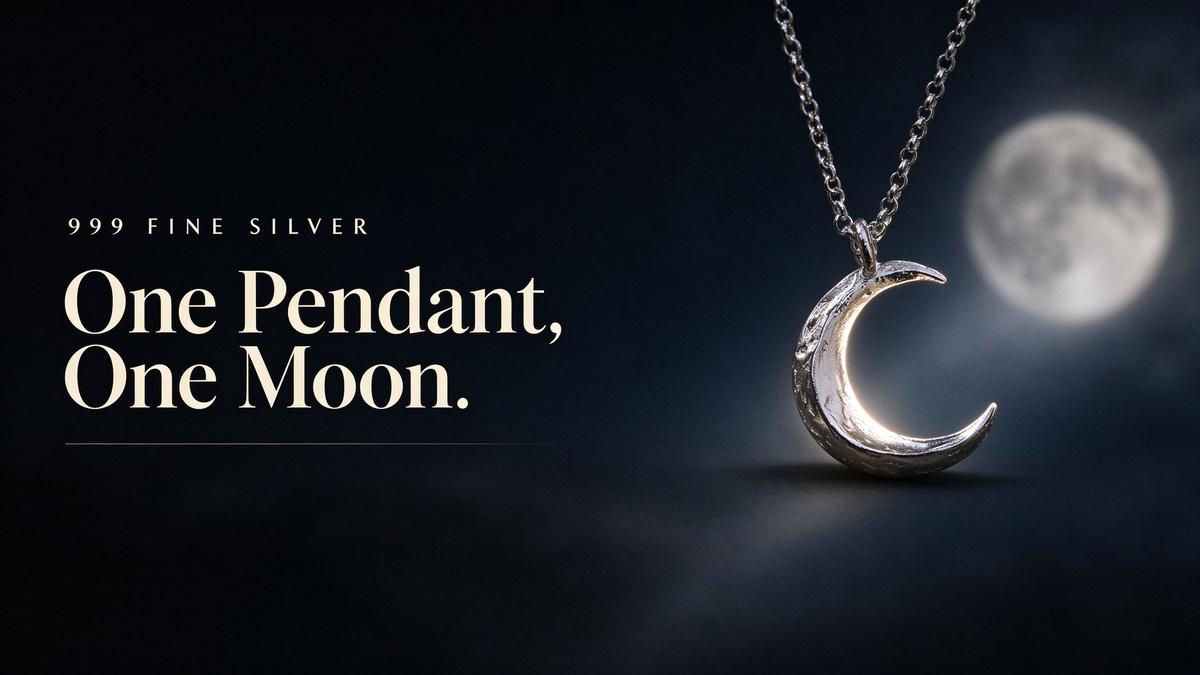
One Pendant, One Moon
The moon was never just the moon.
In the earliest human civilizations, it already carried meaning. The Sumerians worshipped the moon god Nanna and used the crescent as his symbol—a usage traceable to Akkadian cylinder seals from around 2300 BCE. The ancient Egyptians used a crescent-shaped hieroglyph to represent "moon," associating it with the gods Khonsu and Thoth. In China, the crescent shape evolved into the character "月." The Greeks and Romans placed the crescent on the heads of Selene and Diana, making it part of a goddess's identity.
Three thousand years later, the moon is still worn on people's chests.
This Original Handmade 999 Fine Silver Crescent Moon Necklace from Taotaob is a piece that carries this long symbolic history. It is simple, but not herbal. It is quiet, but not empty.
999 Fine Silver: Not Just Purity, But an Attitude
In the world of jewelry, the term "pure silver" is often misused. Most pieces labeled "pure silver" on the market are actually S925 sterling silver—92.5% silver, with the remaining 7.5% being copper or other metals added for hardness. This is not a problem in itself. Sterling silver is a globally recognized standard, suitable for most daily wear.
But this pendant uses 999 fine silver.
999 fine silver contains 99.9% silver. It is the highest purity of silver available in jewelry making. It is softer, with a warmer luster, and lacks the cold, hard white reflection of 925 silver. It is closer to what silver actually is as a metal—a soft, almost liquid brightness.
In the alchemical tradition, silver was always the metal of the moon. Western alchemists paired silver with the moon and gold with the sun. This was no coincidence. Silver's luster does have a moonlight quality—it does not glare, it does not burn. It reflects light in a way that feels more like absorbing light and then slowly releasing it.
Using 999 fine silver for a crescent moon pendant creates an almost inevitable resonance between material and symbol. Silver is the metal of the moon. The crescent is the shape of the moon. Together, they are a match of language and grammar.
Waxing or Waning: Direction Determines the Story
Most people never notice this: the crescent moon has a direction.
Astronomically, the waxing crescent has its horns pointing to the left (from a Northern Hemisphere perspective) and represents the moon's growing phase. The waning crescent has its horns pointing to the right and represents the moon's diminishing phase.
This distinction is not merely astronomical. In symbology, it determines what kind of story the pendant tells.
The waxing crescent—horns pointing left, a moon growing larger—is associated in multiple cultures with new beginnings, growth, and forward-moving energy. If you are starting a new journey, a new job, a new chapter, the waxing moon's direction is outward-growing. It says: I am becoming more.
The waning crescent—horns pointing right, a moon growing smaller—is associated with release, quiet, and letting the past pass. It is not about gaining, but about letting go. It suits those who are walking out of a chapter, those who choose not to carry everything with them.
The direction of a crescent pendant is the wearer's silent self-positioning. Are you someone who is accumulating, or someone who is simplifying? Are you reaching out to the world, or drawing your own space back in?
Taotaob's crescent pendant presents the standard upward-opening crescent shape. In heraldry, when the word "crescent" is used alone, it refers to exactly this horns-up form. This means the pendant's symbol is neutral, open, and does not presuppose a direction. It hands the narrative choice to the wearer. How you wear it determines what story it tells.
Handmade: Why It Still Matters in 2026
This pendant is labeled "handmade."
In the contemporary jewelry market, the word "handmade" has become somewhat cheapened. Big brands also write "handcrafted" on their packaging, but what they mean by "handmade" may simply be that the final polishing step was done by a person. Machines have already done the cutting, shaping, polishing, and plating. A human just looked at it once.
But this pendant comes from Taotaob, a brand built around artisan handwork. Its independent site homepage reads "Artisan Handmade Pearl & Gemstone Jewelry." In this brand's logic, "handmade" means something different: every piece is made by one person, with two hands, one piece at a time.
This means:
No two crescents will be exactly identical. 999 fine silver is relatively soft. When shaped by hand, the curvature of the arc will vary slightly. One may have sharper horns; another may have a fuller body. These differences are not defects. They are the signature of handmade work.
No two pieces are exactly the same. This is the scarcest thing in the industrial age.
In an era when everything can be copied, optimized, and mass-produced, an object that "exists only once" has a rebellious quality. It is not a rejection of efficiency, but a reminder that efficiency is not everything.
Why a Moon Pendant Works for Both Men and Women
There is a notable detail in the product name: "for Men & Women."
The moon has historically been associated with the feminine principle. Selene, Diana, Artemis—these moon goddesses are all female. In alchemy, silver corresponds to the moon and gold to the sun, encoding the duality of yin and yang in metal. In Hinduism, Shiva wears a crescent moon on his head, yet he is a male deity representing transcendence beyond time.
The moon is not a symbol exclusive to any gender. It is a symbol of cycles, change, intuition, and inner rhythm. These qualities do not belong to men or women. They belong to people.
An upward-opening crescent especially carries this neutral quality. It points neither left nor right, suggesting neither "growth" nor "decline." It is an open parenthesis, waiting to be filled. It can be rational or emotional. Restrained or expressive. It depends on who wears it, and who they are on that day.
For male wearers, the pendant's appeal lies in its minimalism and quietness. It does not glitter, does not shout, does not do anything to prove itself. It is just a curve, a piece of silver, a shape. It does not need to be explained.
For female wearers, the appeal may lie in the weight of the symbol. A crescent worn on the chest, close to the heart, is an ancient gesture. The Roman goddess Diana wore the crescent. Medieval Mary stood on the crescent. The modern wearer hangs the crescent between her collarbones. This gesture connects to a very long line.
How to Wear It: Many Possibilities for One Minimalist Pendant
The charm of a minimalist pendant lies in its adaptability. It does not define your style. It follows it.
Wear it alone. This is the most direct way. One silver chain, one crescent, nothing else. The pendant hangs between the collarbones or slightly lower, becoming the sole visual focus of the neck. This style works for any occasion—office, weekend, dinner—because it does not try to be the center of conversation, yet it is always present.
Layer it. A minimalist crescent pendant is an ideal anchor for layering. Pair it with a shorter delicate silver chain or a simple bar necklace to create a sense of layered lengths. The key is length difference—a 16-inch and 18-inch pairing avoids tangling while forming a visual V-line that elongates the neck.
Give it as a gift. A moon pendant is a nearly foolproof gift. It does not discriminate by style, gender, or age. The meaning it carries is specific enough—if you are someone who cares about symbols—and abstract enough—if you simply find it beautiful. Both understandings hold. Both ways of wearing it are correct.
A Silver Moon's Promise
The moon changes every month. It grows from new moon to full moon, then returns to new moon. It has never stopped this cycle. It has never tried to be anything else.
A 999 fine silver crescent pendant is the same. It does not try to be gold, does not try to be diamond, does not try to be bigger, brighter, or more expensive. It is silver, it is the moon, it is a curve. It exists as it is.
This may be its deepest appeal: in a world that constantly urges us to be more, faster, louder, an object that simply and quietly is itself carries a rare kind of honesty.
The Original Handmade 999 Fine Silver Crescent Moon Necklace is now available at Taotaob. Handmade, 999 fine silver, suitable for all genders, minimalist design, carrying three thousand years of symbolic history.